Measuring the success of CLM in 2026: key performance metrics
- Focus on the metrics that matter – track efficiency, process and performance metrics that align with your business goals, rather than measuring everything you possibly can.
- Use data to drive improvement – CLM metrics help legal teams identify bottlenecks, streamline workflows and reduce risk, turning contract management from a black box into a predictable process.
- Leverage the right tools – modern CLM solutions like Summize make it easier to track, visualize and act on contract metrics, allowing teams to collaborate better and make more informed decisions.
Legal teams are increasingly expected to demonstrate the impact of their work, not just deliver it.
As contract volumes grow and commercial pressure increases, it’s no longer enough to say deals are “moving well” or that risk is “under control”. Leadership teams want visibility and data. Measuring the performance of your CLM gives you and your team a way to show how contracting affects revenue timelines, risk exposure, compliance and operational efficiency – and overall helps identify where improvements can be made.
CLM success is measured by tracking how effectively contracts move through the lifecycle, from request and review to approval, signature and renewal. The most important CLM metrics include contract cycle time, approval speed, negotiation rounds, compliance tracking, renewal performance and contract value.
What are CLM metrics?
CLM metrics, or contract management KPIs, are a way to understand how contracts actually move through your business – where things run smoothly and where they slow or break down. They help you see which parts of the contract process need attention, whether it’s legal review, approvals, negotiation or signature.
Why are contract management KPIs important?
Used well, contract management KPIs help teams improve in a few key ways:
- Identifying and resolving bottlenecks early. Tracking how long contracts take at each stage reveals where deals slow down. Once you’ve identified the bottlenecks, you can address the situation and remove all future unnecessary delays.
- Strengthening compliance and accountability. Monitoring obligations, renewals, approvals and deviations from standard terms reduces the risk of missed deadlines, non-compliance or unclear ownership.
- Improving visibility across the contract portfolio. Clear, reliable contract data helps teams understand what’s in progress, what’s signed and what’s coming up, without relying on spreadsheets or inbox searches.
- Supporting better decision-making. Evidence over anecdotes make it much easier to prioritize work, justify resourcing decisions and make targeted process improvements.
{{quote 1}}
Ultimately, CLM software makes contract data structured and visible. CLM then becomes more than a workflow – it becomes a source of business intelligence. Legal teams can see revenue trends, recurring negotiation friction, renewal risk and compliance exposure in real time – and bring those insights into commercial, finance and board-level conversations.
Which CLM metrics and KPIs should you track?
A helpful way to think about CLM metrics is to group them into three broad categories: efficiency, process and performance – assess which area is most important to your business, start measuring and then take action from the results.
CLM metrics to track at a glance
Performance metrics
Performance metrics focus on whether contracts are delivering their intended value and protecting the business once they’re live. This is where CLM moves beyond execution and into risk and revenue protection. Key performance metrics often include:
- Terminated or non-renewed contract value – understanding where and why contracts end early helps teams assess revenue leakage and commercial risk.
- Annual contract value (ACV) – ACV provides context on the financial importance of different agreements and supports comparisons between new, renewed and lost business.
- Compliance and obligation tracking – monitoring whether parties are meeting their contractual obligations helps reduce legal, financial and operational risk.
- Risk and cost indicators – metrics related to disputes, non-compliance or vendor issues can reveal hidden costs and gaps in risk management.
How to improve performance metrics:
- If renewal value is declining, review negotiation patterns and renewal engagement timelines.
- If certain clauses correlate with disputes or early termination, reassess fallback positions and update playbooks.
- If obligation tracking shows recurring compliance gaps, introduce automated reminders or clearer internal accountability.
The goal isn’t just to monitor contract outcomes, but to feed those learnings back into future negotiations and template strategy.
Efficiency metrics
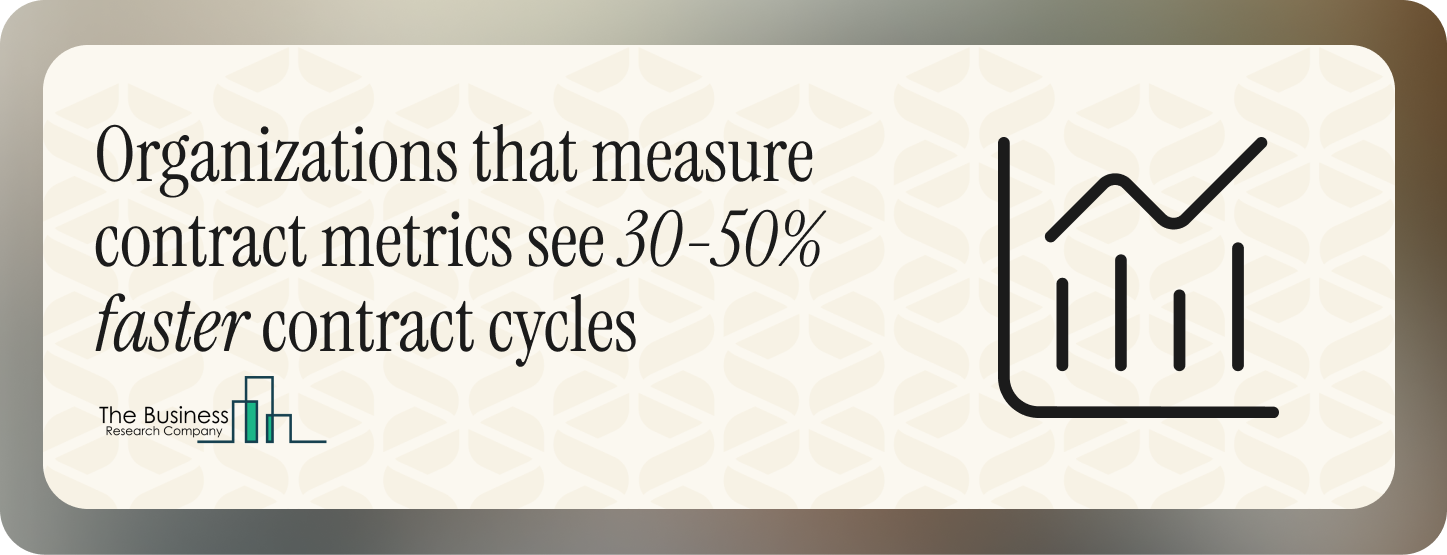
Efficiency metrics measure how quickly contracts progress through their lifecycle. Though difficult to track, they’re also the most revealing, as contracting setbacks often lead to delayed revenue or missed opportunities. Common efficiency metrics include:
- Contract cycle time – the total time it takes for a contract to move from creation to signature.
- Negotiation and revision volume – tracking versions and how long each round takes helps teams identify where friction occurs.
- Delay trends by customer, vendor or region – looking at patterns across different counterparties or locations can highlight structural issues such as local approval bottlenecks or recurring negotiation points.
How to improve efficiency metrics:
- If legal review is the bottleneck, introduce clearer intake requirements, pre-approved playbook clauses for low-risk deals or AI-assisted redlining to handle routine mark-ups more consistently and at scale.
- If negotiations stall repeatedly on the same provisions, review fallback language or align earlier with sales on acceptable positions.
- If regional approval chains are slowing things down, simplify or tier approval thresholds based on contract value or risk.
Process metrics
Process metrics look at how consistently and reliably your contract workflows are operating. They combine volume-based data with quality indicators to show whether contracts are flowing as intended. Examples include:
- Number of contracts created – this provides a high-level view of the demand on the legal team
- Number of contracts completed – comparing completed contracts against the ones initiated can help identify drop-offs or delays at specific stages.
- Contract errors and rework – tracking errors, omissions or repeated corrections highlights weaknesses in templates or intake processes, and helps prevent the same issues happening again.
How to improve process metrics:
- Refine templates to remove ambiguity and reduce manual edits.
- Introduce structured, self-serve Q&A intake forms so key information is captured accurately upfront, reducing back-and-forth and incomplete submissions.
- Clarify ownership at each stage and use triaged workflows to route contracts based on value or risk, preventing stalled handovers and low-risk work clogging senior review queues.
- Provide targeted training where recurring mistakes appear.
Over time, these incremental adjustments create more predictable workflows, which is essential as contract volumes increase.
How should you implement CLM metrics and KPIs?
CLM metrics don’t have to be complicated and tracking the right stats doesn’t have to be overwhelming. Focusing on the contract management KPIs that matter most to your business will allow you to pinpoint bottlenecks, improve efficiency, reduce risk and make better-informed decisions.
Leading CLM solutions like Summize make this process easier. With intuitive dashboards, automated workflows and real-time contract analytics, teams can track cycle times, negotiation rounds, owner responsibilities and more, all in one collaborative space.
Summize customer Thought Machine started measuring their deal lengths and proved to the wider business that with a CLM, their contract cycles reduced dramatically. Legal can prove better efficiency, which improved their relationship with the rest of the business.
{{testimonial 1}}
Curious how structured contract data translates into measurable business impact? Discover how Summize's CLM helps legal teams embed metrics into day-to-day contracting, strengthen collaboration with sales and procurement, and use contract insights to inform smarter commercial decisions.

“Understanding which contracts slow you down and why gives your legal team the insight you need to focus on the deals that really matter. If you start to notice a certain contract or team slowing down legal, you can assess why and look at areas to improve this, like more self-serve training or understanding how to use AI to your advantage.”

With Summize in place, agreements are being signed faster, version control is easier and the legal team has more time to spend on strategic work. We’ve managed to close deals about 40% faster, and we’ve shaved the deal length down from eight months to four. So the business is loving us right now.

Frequently Asked Questions
View allInsights, updates, whitepapers
View all